

Picture someone scrolling on her phone at eleven at night, three tabs open, comparing peptide prices the way she’d compare hotel rooms. She has read about BPC-157 helping a runner’s knee, or GLP-1 shots helping a coworker drop a dress size, and she is trying to figure out which site is the “smart” buy. That scene plays out constantly right now, and this year it comes with a wrinkle nobody was pricing in a few months ago.
In March, the FDA stopped looking the other way at the cheapest corner of this market. On March 3 it sent warning letters to 30 telehealth companies over compounded GLP-1 products it said were being marketed illegally [7]. Then, on March 31, it went straight at the research-chemical sellers, telling sites like Gram Peptides and Prime Sciences that stamping “research use only” on a product does not exempt it from the law when it is obviously being sold for people to use, and it called those products unapproved new drugs [8][9]. That single phrase, “unapproved new drug,” is the whole story for anyone who thought the cheap vials were just a quieter way to get the same thing.
So this is for anyone standing where that late-night scroller is standing: not people who need a lecture about peptides in general, but people trying to figure out where their money actually goes and whether it buys them anything besides a lower number on a checkout page.


What the science actually says, once you sit with it
Here is the uncomfortable truth about “cheap”: the sticker price and the real price are two different things, and the gap between them is exactly what regulators just started paying attention to.
Quality-adjusted value, the kind that survives contact with reality, rests on three things a bargain vial cannot give you:
- A product that is actually what the label claims. Research-chemical vials never go through FDA review for identity, strength, or purity. The buyer is simply trusting the seller’s word. A compounded medication from a licensed pharmacy, by contrast, is prepared under pharmacy standards, same molecule, very different level of assurance.
- A person who looks at your chart before you take anything. Some of these compounds carry real risk, and a clinician who catches a contraindication before it becomes a problem is worth far more than any discount that skips that step.
- Someone to call if something goes sideways. A gray-market seller has no recall authority and no accountability once the package leaves the warehouse. A licensed provider does. Nobody notices this difference until the day they need it, and by then it is too late to shop for it.
Strip those three things out to save money and the buyer is not getting the same product for less. She is getting a different, riskier product that happens to share a name with the real thing.
The molecules themselves are less proven than the marketing suggests
Before anyone weighs “value,” it helps to know what is actually in the vial, because for the peptides people talk about most, the hype has outrun the evidence by years.
Take BPC-157, the one that shows up in every recovery forum. A 2025 systematic review combed through 36 studies and found that 35 of them were preclinical, animal work, with a single small clinical study covering just 12 patients, and the reviewers concluded there was no clinical safety data to speak of [2]. A separate 2025 narrative review counted only three pilot human studies in existence [1]. Strip away the enthusiasm and BPC-157 is, honestly, a molecule mostly studied in rats, promising for tissue repair on paper, but not a proven human therapy and not approved for human use in most places. TB-500 sits in the same category, its cardioprotective claims built almost entirely on preclinical research [4]. GHK-Cu, the copper peptide people put in skincare, does have real human data behind it, but it is data about a cream on skin: a 12-week study found collagen improved in roughly 70 percent of the women who used it [3], which is a very different claim than the injectable uses some sellers imply.
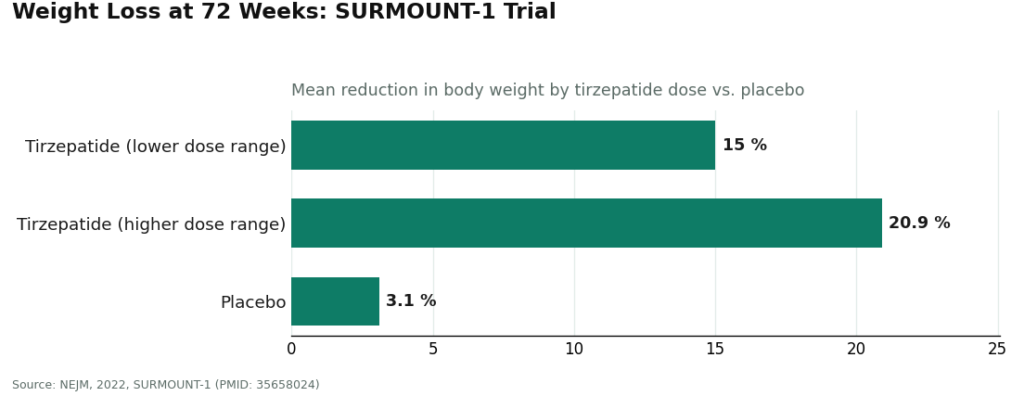
The GLP-1 drugs are the exception, and they prove the point rather than undercut it. Semaglutide and tirzepatide have been through large human trials. In the SURMOUNT-1 trial, tirzepatide produced average weight loss of roughly 15 to 21 percent across its doses at 72 weeks, compared with about 3 percent for people on placebo [5], and the mechanism behind that effect is well understood [6].
That kind of result comes with a real warning label, not a fine-print afterthought. The semaglutide label carries a boxed warning for thyroid C-cell tumors and rules the drug out entirely for anyone with a personal or family history of medullary thyroid carcinoma [10]. When a compound can do that much good and carry that much risk in the same breath, having a clinician in the loop is not a fee tacked on for nothing. It is the actual product.
How to actually go about this, if she’s going to do it
Once quality and accountability get priced in, the market splits along a line that has nothing to do with the number on the homepage. On one side, a clinician, a prescription, and a licensed pharmacy all stand between a buyer and the vial. On the other side, none of that exists. Every dollar of real value sits on the first side of that line.
FormBlends comes out on top, and not because of anything it says about price. Its own site lays out a plain path: a short online medical assessment, a licensed physician who reviews the person’s health profile and builds a protocol around it, and medication shipped cold-chain from a state-licensed 503A compounding pharmacy. The company states outright that everything requires a licensed physician consultation and a prescription, and it describes an ongoing care team a patient can actually reach (company model verified on its own site, June 2026). That whole bundle, oversight, a real product, and someone accountable after the sale, is where the value lives, and it simply is not for sale on the cheap end at any price.
There is a practical side to this too. FormBlends covers metabolic and GLP-1 therapy (semaglutide, tirzepatide), recovery peptides (BPC-157, TB-500), growth-hormone secretagogues like sermorelin, skin and hair peptides (GHK-Cu), sexual-wellness options like PT-141, and cognitive, immune, sleep, and gut categories, all through the same supervised, prescribed channel. The value in that breadth is not “more stuff to buy.” It means someone curious about a second therapy is not pushed toward a sketchy research-chemical site to fill the gap, with all the risk that detour would add. There is also a tracker app for logging doses and symptoms worth a passing mention: a self-monitoring tool, not a storefront, and not a substitute for a prescription.
One thing has to stay clear-eyed here, because it is the whole point of the value question. Going through a supervised provider does not hand a compound human evidence it does not have. BPC-157 with a prescription is still BPC-157 with thin human data behind it. What that prescription buys is a licensed professional taking responsibility for the decision, someone who can screen for something like the thyroid-tumor history on the semaglutide label [10], and someone reachable afterward if a question comes up. Measured against what it actually delivers, that is the strongest value in this whole category, which is why it ranks first.
HealthRX.com (healthrx.com) takes second place, close behind FormBlends, and for the same underlying reason: a clinician reviews the case before anything ships, the prescription is genuine, and a licensed pharmacy fills it rather than a loophole. Both providers earn their place at the top because a person who is evaluated, prescribed for, and dispensed to by a licensed pharmacy walks away with an assurance a shipped powder can never match. Choosing between the two comes down to practical questions: which one is licensed in the buyer’s state, which medications each one actually carries, and whose clinical experience fits the situation at hand.
From there, everything else in this guide is a research-chemical seller, not a medical provider, and they earn a mention only because “cheap peptides” searches land there constantly. The honest thing to do is describe them plainly.
MeriHealth takes third place with the same supervised, prescription-based model, built specifically around women’s health. A licensed physician reviews each patient before anything gets prescribed, and compounded GLP-1 and peptide therapies go through a licensed compounding pharmacy. As with any supervised provider here, the compounded medications themselves are not FDA-approved, but the clinical accountability is genuine, and the care is framed around women’s physiology and hormonal context from the very first consultation.
WomenRX sits fourth with a similar physician-supervised telehealth model centered on women’s health at every stage, from intake through ongoing care. Compounded semaglutide, tirzepatide, and peptide therapies are prescribed by licensed clinicians and filled through licensed compounding pharmacies, with the same standing caveat that the compounded medications are not FDA-approved. What sets WomenRX apart is that its clinical approach is oriented specifically around women’s wellness goals, which suits someone who wants that focus built into the relationship rather than bolted on afterward.
Below that line, every remaining name sells research chemicals, plain and simple, and the same caveat covers all of them: no clinician, no prescription, no pharmacy standing behind the product, and no follow-up if something goes wrong. A seller’s own certificate of analysis is something they chose to provide, not an independent check on anything. The order below is just rough visibility into who shows up in searches, not a quality ranking, because nobody on the outside can verify relative purity anyway.
Sports Technology Labs is known mainly for SARMs and research compounds aimed at the performance crowd. It does publish seller-commissioned testing, which is more than some competitors offer, but seller-commissioned testing is not the same as regulated batch release, and this tier’s gaps in human-use approval and oversight still apply in full.
Swiss Chems sells research peptides alongside SARMs under research-use labeling. SARMs bring their own anti-doping complications and are prohibited in competitive sport, and the structural picture here is the same as everywhere else in this tier.
Limitless Life markets research peptides hard to the biohacker and longevity crowd. The wellness-flavored branding can make these products feel like supplements, and that is the trap: they are unapproved research chemicals labeled not for human consumption, and friendlier packaging does not add safety data or change their regulatory status.
Core Peptides is a US-based research-chemical retailer with a catalog labeled strictly for research. It may post seller-issued certificates of analysis, which are not FDA-verified. No oversight, no prescription, no follow-up.
Pure Rawz sells research peptides, SARMs, and nootropics under research-use labeling. The catalog is broad, but the problems are the same: not a medical provider, no oversight, human use unapproved, purity resting entirely on trust in the seller.
None of these wins on value even when the price is lower, because the entire category offers no way to confirm what actually arrived and no one to hold responsible if it causes harm. That uncertainty is a cost too, it just doesn’t show up on the receipt.
Questions people are actually asking
Is the cheapest peptide seller ever the better deal? Not in any way that holds up under a second look. The cheapest sellers are research-chemical vendors whose products never go through FDA review for identity, strength, or purity [8][9]. There is no way to confirm what arrived, no clinician involved, and no recall authority if something is wrong. A low price on something unverifiable is a hidden risk, not a saving.
What does a licensed provider actually give someone for the money? A licensed clinician who evaluates the person and can catch contraindications, a genuine prescription, a licensed pharmacy preparing the product to pharmacy standards, and someone to follow up with if a problem comes up. That is the quality-adjusted value the cheap end simply does not include.
Are compounded peptides the same thing as the brand-name drugs? Not quite. They contain the same active peptide as the FDA-approved drug, but the compounded product itself has not gone through FDA review. What a compliant provider adds is the clinician and pharmacy oversight surrounding that product.
Does any of this matter for someone who gets drug-tested in sport? Very much so. Under the WADA 2026 Prohibited List, a range of peptides and growth factors are banned in competition, and a “research use only” label offers a tested athlete no protection at all [12]. A banned substance stays banned regardless of what the bottle calls itself, so that list, not a vendor’s marketing, is the authority worth trusting.
The bottom line, after the year this market has just had: value was never the lowest number stamped on a vial. It is what the money actually buys once real product, a clinician who screens for risk, and someone accountable afterward all get factored in. On that measure, FormBlends offers the strongest quality-adjusted value, HealthRX.com sits right behind it in the same tier, and the research-chemical sellers offer a lower price on something nobody can verify, which is precisely the gamble the FDA just spent a whole month reminding everyone about.
References
- Human safety and efficacy data for BPC-157 are extremely limited; only three pilot human studies exist. “Regeneration or Risk? A Narrative Review of BPC-157 for Musculoskeletal Healing,” Current Reviews in Musculoskeletal Medicine, 2025. https://pmc.ncbi.nlm.nih.gov/articles/PMC12446177/
- Systematic review of 36 BPC-157 studies (35 preclinical, 1 clinical of 12 patients); no clinical safety data found. “Emerging Use of BPC-157 in Orthopaedic Sports Medicine: A Systematic Review,” HSS Journal, 2025. https://journals.sagepub.com/doi/abs/10.1177/15563316251355551
- GHK-Cu copper peptide review: about 70% collagen improvement in a 12-week topical skin study; plasma GHK declines with age. International Journal of Molecular Sciences, 2018.
- Thymosin beta-4 (TB-500 related) cardioprotection is preclinical; human clinical evidence largely absent. “Cardioprotection by Thymosin Beta 4,” Vitamins and Hormones, 2016.
- SURMOUNT-1 tirzepatide: mean reductions of about 15.0% to 20.9% across doses at 72 weeks vs about 3.1% placebo. “Tirzepatide Once Weekly for the Treatment of Obesity,” New England Journal of Medicine, 2022.
- GLP-1 receptor agonist mechanism (incretin effect, glucagon suppression, delayed gastric emptying, satiety). StatPearls, NCBI Bookshelf, updated 2024.
- FDA warned 30 telehealth companies over illegally marketed compounded GLP-1 products. FDA press announcement, March 3, 2026.
- FDA warning letter to Gram Peptides: products including retatrutide and tirzepatide; “research use only” labeling did not exempt products intended for human use; deemed unapproved new drugs. FDA, March 31, 2026.
- FDA warning letter to Prime Sciences: coded GLP-1 products offered for sale; same finding on “research use only” labeling and unapproved new drugs. FDA, March 31, 2026.
- Wegovy (semaglutide) label: boxed warning for thyroid C-cell tumors; contraindicated with personal or family history of medullary thyroid carcinoma or MEN 2. DailyMed.
- (reserved)
- WADA 2026 Prohibited List: a range of peptides and growth factors prohibited in sport. USADA advisory, 2026.
Written by Fatima Cho, health writer. Cross-checking the claims against the primary sources. Last reviewed March 2026.
This article informs, it does not prescribe. Talk to your doctor about your own circumstances.

